Hybrid Human–Machine Creation: a free AI art course for CAA and Zhejiang University
A micro-course for the joint "Intelligent Art and Design" programme of the China Academy of Art and Zhejiang University, now free on Zhihuishu: from the art history of AI-native art to five hands-on vibe-art exercises with multi-agent systems.
Translated by AI
Originally published on 微信公众号
At the invitation of Wu Ziyang of the China Academy of Art, I co-created a micro-course for the joint micro-programme “Intelligent Art and Design” run by the China Academy of Art and Zhejiang University. It is now live on the Zhihuishu platform: search for Hybrid Human–Machine Creation Methods (人机混合创作方法) and register to study for free.
Link: coursehome.zhihuishu.com/courseHome/1000164059
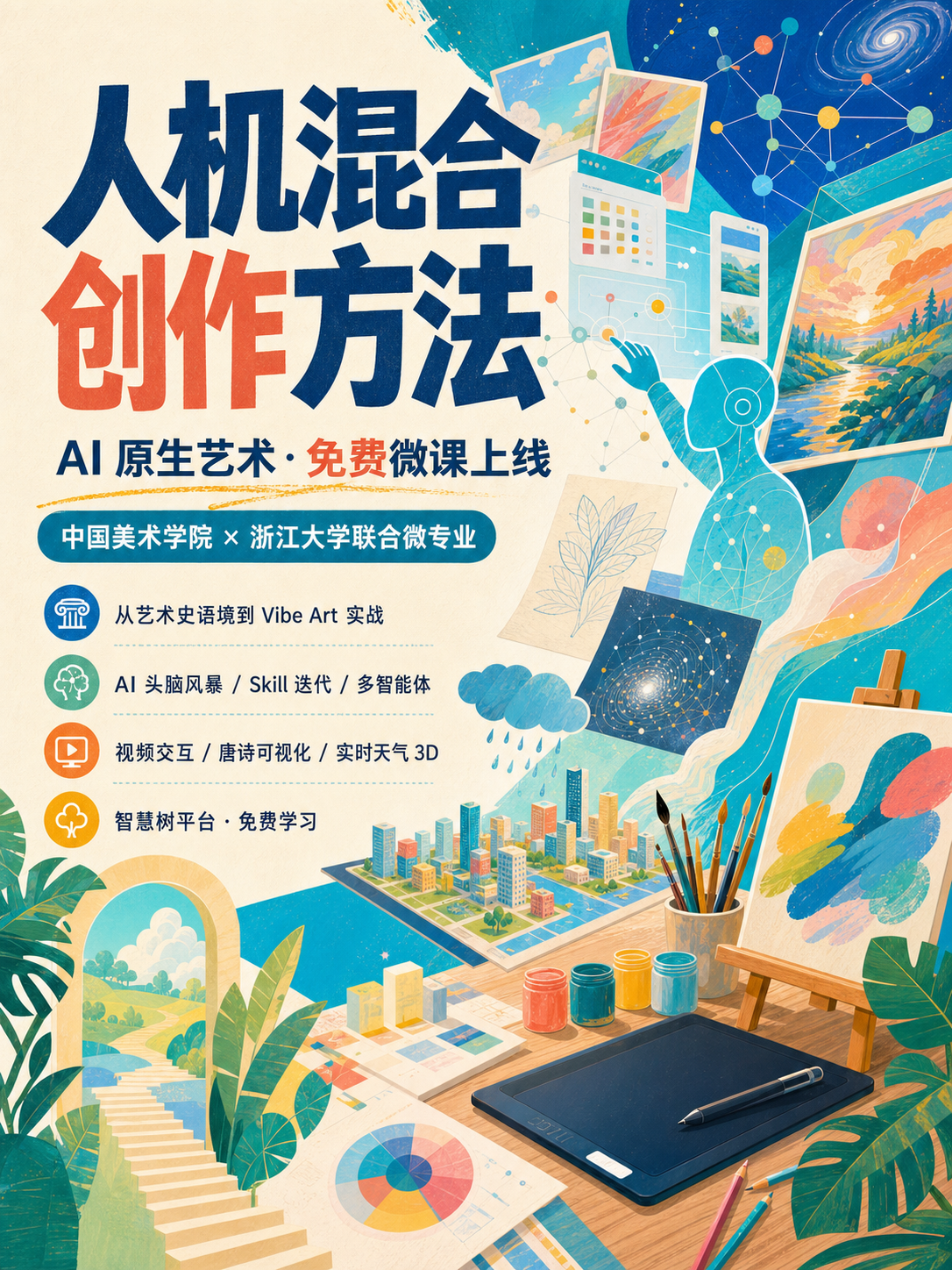
The course is introductory and focuses on AI-native art in a contemporary-art context. Chapters 1–5, taught by Wu Ziyang, trace the art history relevant to AI-native art. From chapter 6 it’s my part: first my own understanding and practice of AI-native art, then, in chapters 7 and 8, a hands-on introduction to vibe art:
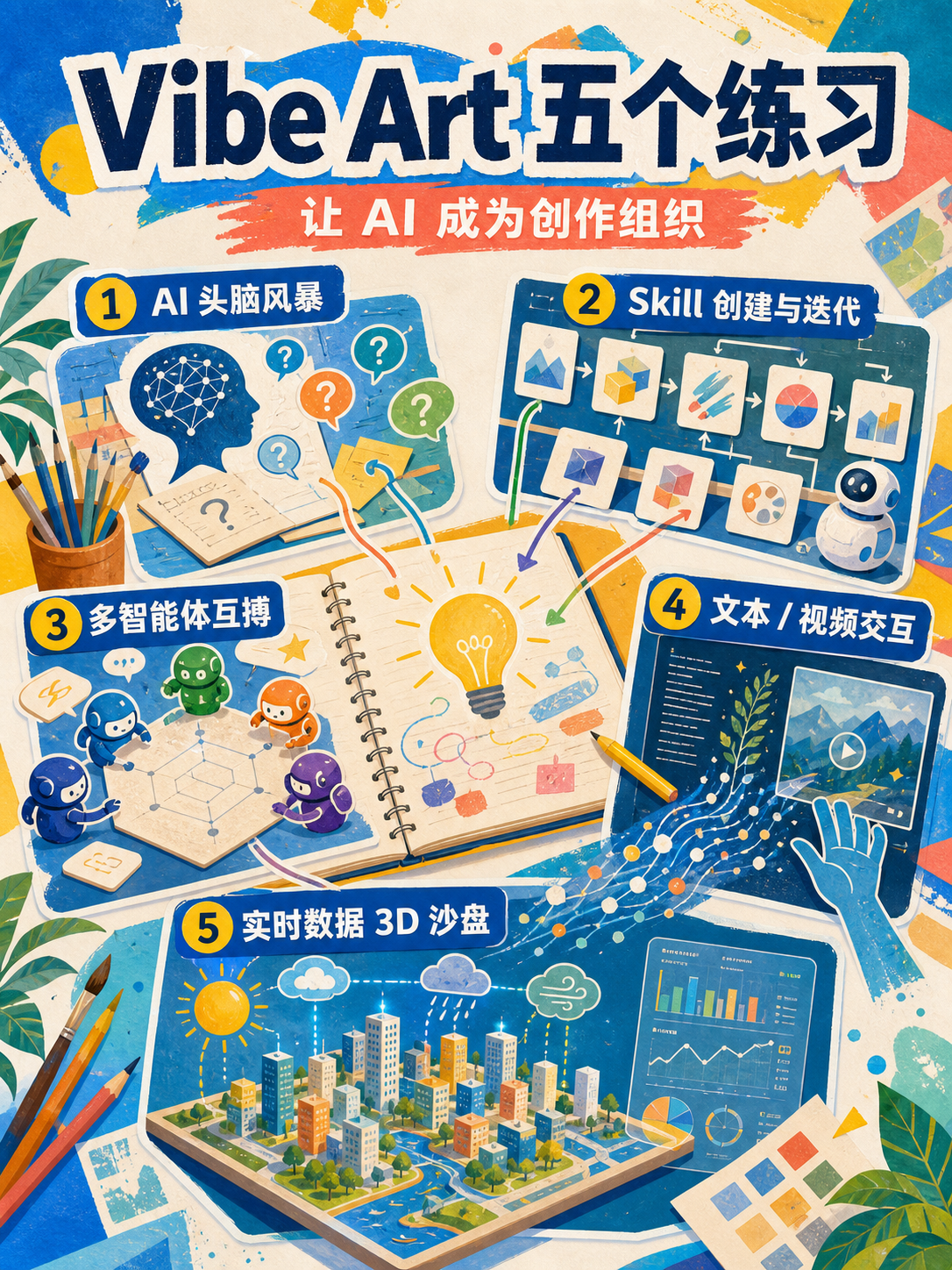
- Brainstorming with AI to push boundaries: a brainstorming skill that makes the AI question itself to widen the scope of the work, combined with p5.js for generative art.
- Creating and evolving skills: turning Li Jigang’s “round-table” prompt, step by step, into a multi-agent “art academy” architecture for collaborative creation.
- Agents arguing with each other: orchestrating several agents with multimodal generation and understanding, so they compete in image generation and critique.
- Beyond text: interaction and data: having agents visualise a large text such as Three Hundred Tang Poems, or react to live video for a gesture-driven particle piece.
- Live data driving 3D: connecting external data APIs to build a real-time 3D weather model of a city.

For compliance reasons the demos mainly use ByteDance’s Trae Solo with MiniMax M3, but the point is the thinking and method, not the tools. If you use Codex or Claude Code, the frameworks carry over directly — usually with better results.
The course was prepared in a hurry; bug reports and corrections are welcome.